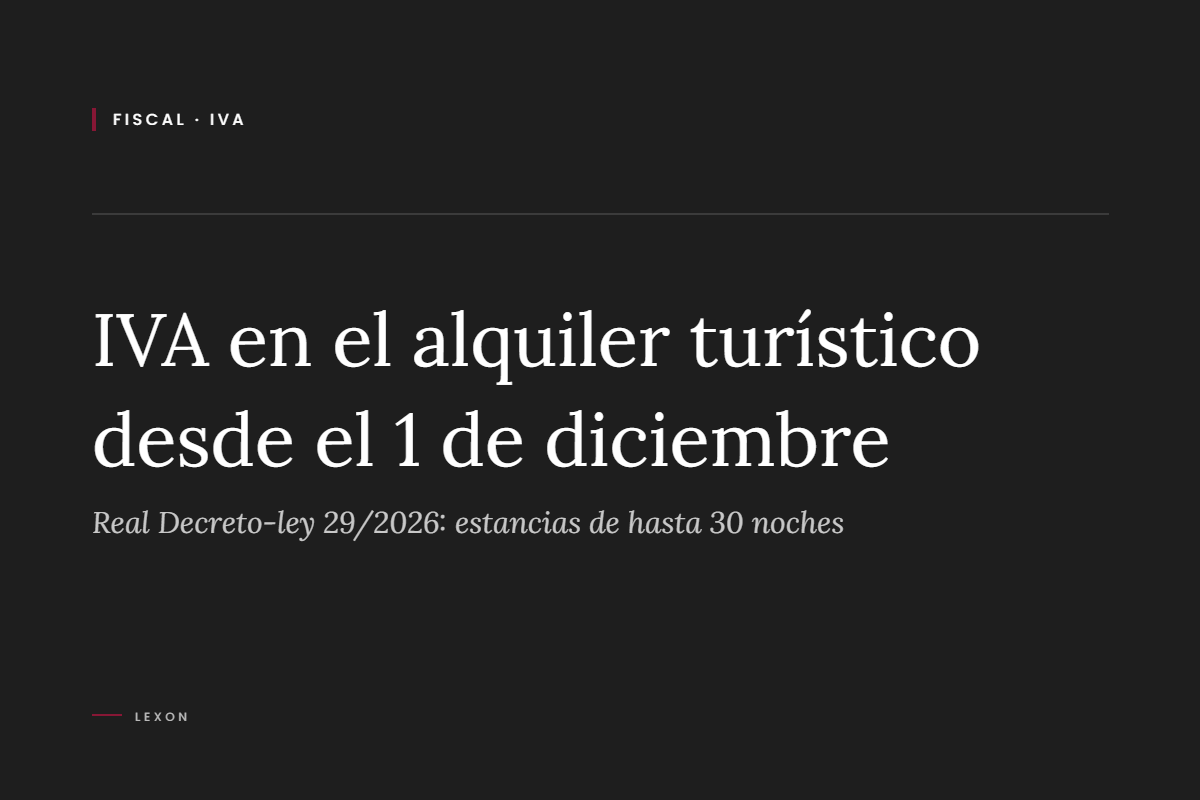
Until 30 November 2026, letting a furnished home to holidaymakers without hotel-type services was, for Spanish VAT purposes, an exempt residential letting. From 1 December it is not, whenever the stay granted to the same guest does not exceed thirty nights. The change comes from Article 7 of Royal Decree-law 29/2026 of 6 October, ratified by the Standing Committee of the Congress of Deputies on 12 November, and it reaches the heart of the holiday rental market in Mallorca, including properties owned from abroad. It is not simply an extra cost, however: once the letting is taxable, the owner may recover the VAT incurred on it.
What the VAT Act now says
Letter e') of Article 20.One.23 of the Spanish VAT Act (Law 37/1992) now removes the exemption from lettings of furnished apartments and homes in either of two cases. The first is not new: the landlord undertakes to supply services typical of the hotel trade, such as catering, cleaning or laundry. The second is: the letting to the same tenant lasts thirty nights or fewer, whether or not any services are supplied. Article 91.One.2.2 brings these lettings within the 10% reduced rate that already applies to hotel accommodation.
A short stay in the landlord's own main home, such as a room let in the house where the owner lives, remains exempt. As drafted, however, that carve-out only displaces the duration test: if hotel-type services are supplied, the stay is taxable regardless. Nor does the charge depend on the property being registered as a tourist let.
The owner charges the VAT, resident or not
The person liable is whoever lets the property: an individual, a company or, where the co-owners organise the letting jointly and share its risk, the co-ownership itself as a comunidad de bienes (Article 84.Three), which must register with its own tax number; this is common for married couples who hold a home in equal shares (ruling V1544-26 of 15 June 2026). Before the first taxable stay, the owner must register for VAT on Form 036. From then on, invoices must carry 10% VAT, the VAT books must be kept, and quarterly returns (Form 303) must be filed, together with the annual summary (Form 390) unless the owner is exempt from it.
Non-resident owners are in the same position, because the service is treated as supplied where the property is located (Article 70.One.1). A rented home with no staff of its own is not a fixed establishment for VAT purposes, as the Court of Justice of the European Union held on 3 June 2021 in Case C-931/19, Titanium, but that does not relieve the owner from registering in Spain. An owner resident outside the European Union, in a country without mutual assistance arrangements comparable to those within the Union, must also appoint a VAT representative (Article 164.One.7). Income tax is unaffected: the rental income is still reported on Modelo 210, and the VAT charged to guests does not form part of it.
What becomes recoverable
From 1 December, input VAT on the running of the let becomes deductible: cleaning, utilities, furniture, refurbishment and platform commissions. Since 2023, platforms not established in Spain charge Spanish VAT on their commission for intermediating in the letting of homes located here, with no reverse charge (Article 84.One.2(a)(e'), as amended by Law 31/2022), whether the owner is resident or not. While the letting was exempt, that VAT was a sunk cost, as we explained in our note on holiday letting and tax in Mallorca; it now becomes deductible provided the invoice is issued in the owner's name, so it is worth checking how each platform invoices.
The effect may extend to the property itself. Where the home was bought new, with VAT, within the last ten years and already for letting, part of the VAT not deducted at the time can be recovered through the capital goods adjustment (Articles 107 to 110): one tenth for each remaining year of the period, provided the deductible proportion for that year differs by more than ten points from the year of purchase. A home bought in 2020 with €50,000 of VAT would yield €5,000 in each of 2027, 2028 and 2029 if all the owner's activity in those years is taxable; 2026 will depend on its final deductible proportion, in which only December counts. A resale property bought with transfer tax, or one bought more than ten years ago, gives nothing to adjust, and personal use for part of the year reduces the deduction in proportion to the actual use in the business (Article 95.Three), with the property recorded in the owner's VAT books.
Buyers acquiring a property now in order to let it can deduct the VAT on a purchase from a developer and, on a resale, may consider waiving the exemption (Article 20.Two) so that the purchase bears VAT instead of transfer tax. The extension of the reduced rate to renovation works (Article 91.One.2.10) does not help them: it is confined to homes let as a tenant's main residence.
Bookings already paid: the delicate point
The Royal Decree-law contains no transitional rule. The general principle therefore applies: the treatment in force when VAT becomes chargeable governs, which for lettings is when the rent becomes payable (Article 75.One.7) and, for advance payments, on receipt and to the extent of the amount received (Article 75.Two).
On that basis, our reading is that a deposit actually received before 1 December for a later stay was covered by the exemption in force when it was paid, and that only the balance, received from that date, bears 10% VAT. This is the approach the Directorate General of Taxes takes for advance payments when the VAT rate changes (ruling V1435-10, which requires the stay to be precisely identified) and for advances on exempt supplies (ruling V1292-20), although it has not ruled on the removal of an exemption. A prepayment made for no reason other than to avoid the tax may be challenged.
There is also a commercial consequence. Where a booking was agreed at a final price and the contract does not allow the tax to be passed on to the guest, the VAT will come out of that price, in line with the judgment of the Court of Justice of the European Union of 7 November 2013 in Joined Cases C-249/12 and C-250/12, Tulică and Plavoşin. New rates should already be set inclusive of VAT.
A change that is here to stay
The reform anticipates Directive (EU) 2025/516 on VAT in the digital age, which treats uninterrupted lettings to the same person of up to thirty nights in the same way as hotel accommodation and will make platforms liable to collect the VAT in certain cases, optionally for Member States from July 2028 and compulsorily from January 2030. Owners can reasonably plan on the basis that the new treatment will last.
What to review before 1 December
- The length of stays and who owns the property, including whether a co-ownership should register.
- VAT registration and, where required, the appointment of a representative before the first taxable stay.
- Deposits already received, new rates and the settings on each booking platform.
- Invoices for the purchase, works and furniture, to quantify the VAT that can be deducted or adjusted.
Conclusion
Holiday lets of up to thirty nights are now taxed like hotel stays. Owners who organise themselves in time may find the net cost lower than it first appears; those who do not risk building up unpaid VAT from the first stay in December.
At Lex·on we advise resident and non-resident owners of holiday rental properties on VAT registration, periodic returns and the recovery of input VAT, from Palma de Mallorca and Manacor, as part of our tourist licence and rental operations service. If your property is let for short stays, it is worth reviewing your position before 1 December.
Tramuntana Tax, the international desk run by the same partners, also explains the tax side of holiday rentals in Mallorca.
Source: Article 7 of Royal Decree-law 29/2026 of 6 October on urgent measures to protect the social function of housing and expand the supply of affordable housing, and Resolution of 12 November 2026 of the Congress of Deputies ordering publication of the agreement ratifying it; Articles 20.One.23 and 20.Two, 70.One.1, 75, 84.One.2 and 84.Three, 91.One.2, 95, 107 to 110 and 164.One.7 of Law 37/1992 on Value Added Tax; Council Directive (EU) 2025/516 of 11 March 2025 amending Directive 2006/112/EC as regards VAT rules for the digital age; judgments of the Court of Justice of the European Union of 7 November 2013, Joined Cases C-249/12 and C-250/12, Tulică and Plavoşin, and of 3 June 2021, Case C-931/19, Titanium; Article 75 of Law 31/2022 of 23 December; binding rulings of the Directorate General of Taxes V1435-10, V1292-20 and V1544-26.
© Lexon Advisory, S.L.U. All rights reserved. The total or partial reproduction of this content, by any means or procedure, without the express written authorisation of its owner is prohibited. Any unauthorised use will constitute an infringement of intellectual property rights under applicable law.
This article is for information purposes only and reflects the administrative position in force on the date of publication. It does not constitute legal or tax advice and does not replace an individual analysis of each case.